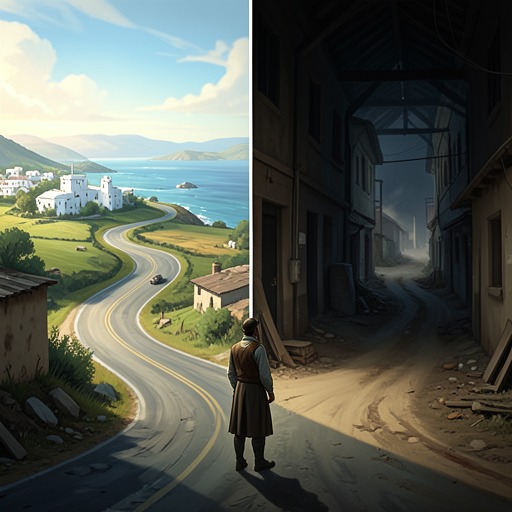
Melancholy
The Myth of SisyphusMelancholy is not a single psychological condition in this book but a recurring state produced when desire, memory, and knowledge collide with an unalterable world. It appears in the defeated return toward the rock, in the rain-darkened ruins of Tipasa, in the hope sustained by an inaccessible Castle, and in the historical consciousness of an age that has lost its former innocence. Its defining movement is double: melancholy wounds by exposing what cannot be recovered, yet that same exposure can become lucidity, measure, and even a form of freedom.
Definition and Contrasting Forms
Melancholy is distinguished from ignorance and from hope that still projects an escape. Don Juan, for example, is judged unlikely to be melancholy because he knows and does not hope. His laughter, playfulness, and repeated movement from woman to woman express a consciousness of limits rather than sorrowful expectation. The text locates his earlier melancholy in the period when he hoped; once he recognizes the finite, imperfect character of life, the knowledge becomes bitter but also consoling. Melancholy therefore belongs especially to the interval in which a person still feels the pressure of what has been lost or desired, before lucid acceptance has fully displaced expectation.
The book also refuses to treat melancholy as the opposite of happiness in any simple sense. In the descent toward his rock, Sisyphus may return in sorrow, but he may also return in joy. Sorrow arises when images of earth cling too tightly to memory and the call of happiness becomes too insistent: the rock then seems to have won. Yet crushing truths can lose their power once they are acknowledged. Melancholy is thus both the weight of memory and the first movement toward consciousness; its force depends on whether the individual remains possessed by the loss or recognizes the condition that produced it.
Melancholy and Consciousness
Sisyphus provides the clearest philosophical image of melancholy as a conscious interval. After the stone rushes back down, he descends toward the plain before beginning the labor again. That pause is the hour in which he understands his situation. His measured return is not merely another stage of punishment: because he knows the extent of his wretchedness, he becomes superior to his fate and stronger than the rock. The consciousness that makes his condition tragic also crowns his victory, since no fate is beyond being surmounted by scorn.
The same structure appears through Sophocles’ Oedipus. At first, Oedipus obeys fate without knowing it; tragedy begins when knowledge arrives. Blind and desperate, he nevertheless recognizes that his remaining bond with the world is the cool hand of a girl, and he concludes that, despite his ordeals, age, and the nobility of his soul, all is well. Melancholy here does not end in restoration or ignorance. It belongs to the moment when suffering is fully seen but does not exhaust the world. Ancient tragedy and modern absurd heroism meet in the claim that recognition can transform defeat without abolishing it.
Memory, Place, and Historical Loss
In the essay set in Algiers and Tipasa, melancholy takes the form of an attempted return to youth. After five days of rain, the narrator walks through December Algiers, a city remembered as a place of summers, but finds its laughter emptied and its people reduced to bent, shining backs. In the cafes, familiar faces reveal the passage of age: they had been young with him and were no longer so. The city does not simply recall the past; it makes the irreversibility of time visible.
The return to Tipasa intensifies that wound. More than twenty years earlier, the narrator had wandered among ruins, breathed wormwood, warmed himself against stones, discovered small roses, and slept beneath a sky crowded with stars. On a later visit, the ruins remain near the waves, but barbed wire restricts entry, nighttime walking is forbidden, and an official guardian is present. Rain covers the site. The physical barriers become a figure for the historical barriers separating the earlier world from the present one, while the changed landscape mirrors the narrator’s own distance from youth.
That personal loss is inseparable from the catastrophe of history. On September 2, 1939, the narrator did not go to Greece as planned because war came instead and later spread there. The distance between warm ruins and barbed wire exists within him as well. Tyrannies, war, police forces, and the era of revolt replaced the unselfconscious abundance in which beauty had once seemed sufficient. Empires fell, nations and individuals attacked one another, and innocence gave way to involuntary guilt. Melancholy therefore records not private nostalgia alone but the historical aging of a generation that discovered morality only after its hands had been soiled by events.
Melancholy and Frustrated Hope
In The Castle, melancholy is generated by hope that repeatedly survives its own disappointment. K. arrives in the village as Land Surveyor appointed to the Castle, yet communication between village and Castle remains impossible. Every advance achieved through persistence, trickery, or good will produces another frustration, and each chapter becomes both a defeat and a new beginning. Telephone calls yield confused voices, vague laughter, and distant invitations; these inadequate signs are nevertheless enough to sustain hope.
Olga gives the state its clearest expression when she becomes sad at the prospect of Barnabas’s probably futile trip to the Castle, his probably wasted day, and his probably empty hope. The repeated qualification is crucial: the possibility of failure is never removed, but neither is it confirmed with finality. Melancholy grows in that narrow space between certainty and refusal, where an inaccessible goal continues to organize conduct. The very absence of resolution becomes the source of the work’s distinctive sadness.
Frieda’s attachment to K. exposes another form of the same mechanism. She says that she feels forsaken when he is absent, even though knowing him has drawn her toward a void and a nameless pain. Suffering acquires a privileged aspect because it is also the medium through which attachment and hope arise. Melancholy is therefore not merely a withdrawal from desire; it can make the crushing object more lovable, preserving the emotional energy of a quest that offers no secure issue.
Historical and Artistic Significance
The book places melancholy within a wider contrast between Greek measure and modern European excess. Greek tragedy could join despair to beauty, whereas modern Europe feeds despair on ugliness and convulsion. The Greeks recognized limits and balanced shadow with light; modern history pursues totality, rejects what it does not glorify, and repeatedly extends its own boundaries. Nature still offers calm skies and reasons against the madness of men, but the existence of limits does not prevent them from being exceeded or the transgressor from being punished.
This historical consciousness changes the meaning of melancholy. It is no longer simply a private mood but the feeling of inhabiting a civilization that has exiled beauty while aspiring to absolute justice, reason, and power. The narrator chooses history over the eternal because history is certain and because he cannot deny the force crushing him. He also recognizes that contemplation and action cannot be reconciled without strain: to choose action is to ally oneself with time, while the eternal offers another form of escape. Melancholy names the pain of that choice without allowing nostalgia or bitterness to substitute for clear sight.
Art offers a disciplined response to this condition. The artist, unlike the historical spirit, knows limits; the historical spirit seeks tyranny, while the artist’s passion tends toward freedom. Yet the artist cannot remain outside collective suffering. The miner exploited or shot down, people held in camps, colonial subjects, and persecuted populations need those who can communicate their silence. The narrator’s writing is drawn toward the humiliated and debased not because he has abandoned creation for social preaching, but because he cannot tolerate a world in which their hope is removed. Melancholy thus becomes ethically productive when it refuses both aesthetic isolation and ideological consolation: it keeps loss visible, preserves sympathy, and turns lucid suffering into language.